2025 © Tommaso Gioia - All Rights Reserved
 |  |  |  |  |
|---|---|---|---|---|
 |  |  |  |  |
 |  |  |  |  |
 |  |  |  |  |
 |  |  |  |  |
 |  |  |  |  |
 |  |  |  |  |
 |  |  |  |  |
 |  |  |  |  |
 |  |  |  |  |
 |  |  |  |  |
 |  |  |  |  |
 |  |  |  |  |
 |  |  |
VIETNAM 50 YEARS LATER
Thinking of Vietnam, it is impossible not to return to April 30, 1975—the date of the long-awaited reunification after more than a century of wars for independence. First against the French, who settled along the banks of the Mekong under the guise of a protectorate—though their true aim was to exploit the region’s natural and mineral resources—and later against the Japanese, who established military control in September 1940, initially in Tonkin and then in the south of what was then French Indochina. It was only following the atomic bombings of Hiroshima and Nagasaki by the Allies (in August 1945) that this occupation came to an end, allowing for the return of French dominance.
American intervention began under President Kennedy with the deployment of “military advisors” and escalated during the Johnson administration, when the United States began sending combat troops to what was then South Vietnam. Previously supported with financial aid and military supplies, the American presence grew exponentially, reaching a peak of 600,000 soldiers in 1968.
Despite massive bombing campaigns—particularly along the so-called Ho Chi Minh Trail—and ongoing battles during Nixon’s presidency, the resistance of the Viet Cong and their allies never wavered.
In January 1973, an agreement was reached among all parties involved, calling for the complete withdrawal of U.S. forces. Two years later, on April 30, 1975, the communists entered Saigon with the cry of Giai Phóng (liberation), finally reunifying the country.
That Second Indochina War, which had ignited public opinion in the West from the mid-1960s onward—mobilizing civil rights protests and opposition to American escalation—deeply unsettled Western conscience. Hollywood has since attempted, time and again, to portray the psychological and indelible scars it left on the minds of its participants.
Conversely, that victory became a symbol of pride for socialist movements—the first time a socialist force had triumphed over the formidable U.S. military machine, despite the enormous economic and technological disparity. Today, reminders of that struggle are on display in the war museums across the country.
But what is Vietnam today? What has become of this socialist republic 50 years after reunification? Who are the Vietnamese of the 21st century?
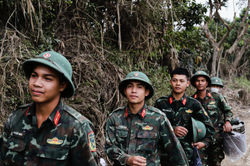
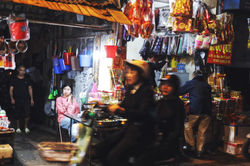
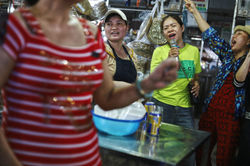
These are the questions that inspired me to develop this photographic project—an attempt, however partial, to offer an answer through the images I have taken over the past decade.
The other fundamental reason that led me to travel and recount Vietnam through its distinctive features is my deep love for this country—born during my teenage years through the pages of books by Tiziano Terzani, Graham Greene, and Stanley Karnow—which I now consider my second home.