2025 © Tommaso Gioia - All Rights Reserved
 |  |  |  |  |
|---|---|---|---|---|
 |  |  |  |  |
 |  |  |  |  |
 |  |  |  |  |
 |  |  |  |  |
 |  |  |  |  |
 |  |  |  |  |
 |  |  |  |  |
 |  |  |  |  |
 |  |  |  |  |
 |  |  |  |  |
 |  |  |  |  |
 |  |  |  |  |
 |  |  |  |  |
 |  |
BORN LOST
Child labour, which according to a 2020 UNICEF estimate affects more than 160 million children worldwide, remains a plague that even the most advanced and hyper-technological societies of the third millennium struggle to eradicate. It is a vicious system that tolerates the exploitation of children across various production and processing sectors in many developing countries—especially in Pacific Asia and sub-Saharan Africa—enabled by weak legislation and the lax approach of supervisory bodies.
The causes of child labour are manifold: poverty in the countries where these children live and the resulting lack of decent and regulated job opportunities; limited access to quality education; conflicts that force people to migrate and live in emergency conditions; criminal networks that enslave minors through human trafficking, including for sexual exploitation; and deeply rooted social and cultural norms based on castes, ethnic traditions, and popular beliefs.
Poverty is the main factor that forces children to work in order to support themselves and their families. Many people are poor because the overall economies of their countries are weak—either due to a lack of resources or to poor governance that prevents all social groups from equally benefiting from available resources. Sixty-one percent of the world’s population lives on less than $10 a day—or even without any income—relying on subsistence agriculture. Forty percent of the population in sub-Saharan Africa survives on less than $1.90 a day. More than 69 million children suffer from malnutrition, 75% of whom live in developing countries (World Bank).
The belief that work is preparatory to a child's future role—often mirroring that of their parents—contributes to the spread of the phenomenon. Local customs, such as incurring debt for social or religious events, lead some families to abuse or even sell their children (notably in Bangladesh, India, and Nepal) to repay what they owe.
The practice of employing children in family businesses is deeply rooted in some cultures. Parents often do not recognize the harm caused by putting their children to work—unpaid—in their shops or on their farms (this accounts for 72% of child labour worldwide). Twenty-five percent of children aged 5 to 11 are engaged in jobs that endanger their health and morality. In rural areas, around 122.7 million children are employed in agriculture globally—much higher than the 37.3 million in urban areas. More than three-quarters of children working in agriculture between the ages of 5 and 11 (often not even registered at birth) are compelled to work by their families.
Labour also hinders school attendance—the only real alternative—or undermines academic performance when children try to balance both responsibilities. The issue of non-schooling, especially prevalent in sub-Saharan Africa and Southern Asia, condemns these future adults—often illiterate or lacking basic skills—to a lifetime of poorly paid work. Even when education is free, poor families may consider it unsustainable due to the loss of potential income. There is a clear correlation between school attendance and child labour: 25% of children aged 5 to 11 who are not enrolled in school, and 35% of those aged 12 to 14, are working.
The lack of schools and qualified teachers in many areas further contributes to child labour. Girls are more frequently withdrawn from school than boys, due to the persistent belief that they require less education. Countries with the largest gender disparities in school attendance include Pakistan (82 girls per 100 boys) and Afghanistan (71 per 100). Many girls stay at home to perform domestic chores or work in family businesses; others are sold into slavery or prostitution.
Efforts to raise awareness among parents—many of whom experienced the same conditions as children—about the damaging effects of illiteracy or the immorality and illegality of child labour, rarely yield results. Families need to see for themselves the tangible benefits that education can bring.
Non-profit organizations and NGOs working to combat child labour understand the necessity of first rehabilitating these children—who almost always have a history of violence and abuse—before introducing them to any educational path. The greatest challenge is changing the widespread belief (shared by 72% of affected children) that “the street” and work are the only possible options in life. Orphans (more than 150 million globally) and children from disadvantaged families in many developing cities are often forced to live on the streets, internalizing a distorted value system. Only the youngest, involved in prostitution or other criminal activities and not yet addicted to drugs, have a genuine desire to change.
The strategy of these organizations is to empower parents or guardians, helping them become self-sufficient by training them in income-generating professional skills. They are then made responsible for the healthy development of their children. In addition to education, children are provided with free meals, school supplies, healthcare, clothing, and—if they are orphans—a safe environment in which to grow.
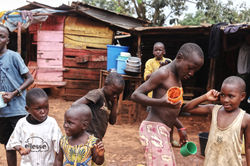
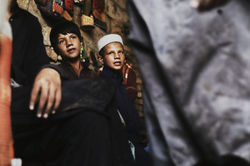
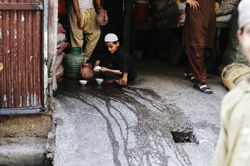
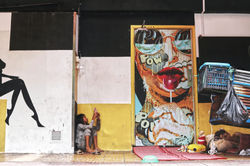
This photographic project, developed over five years across multiple continents, seeks to explore the perspectives and emotions of underage workers; to depict the environments in which they grow up; to document the efforts of organizations committed to their rehabilitation; and, above all, to reveal the human spirit that—though often misled, abused, and repressed—resides within each of us.